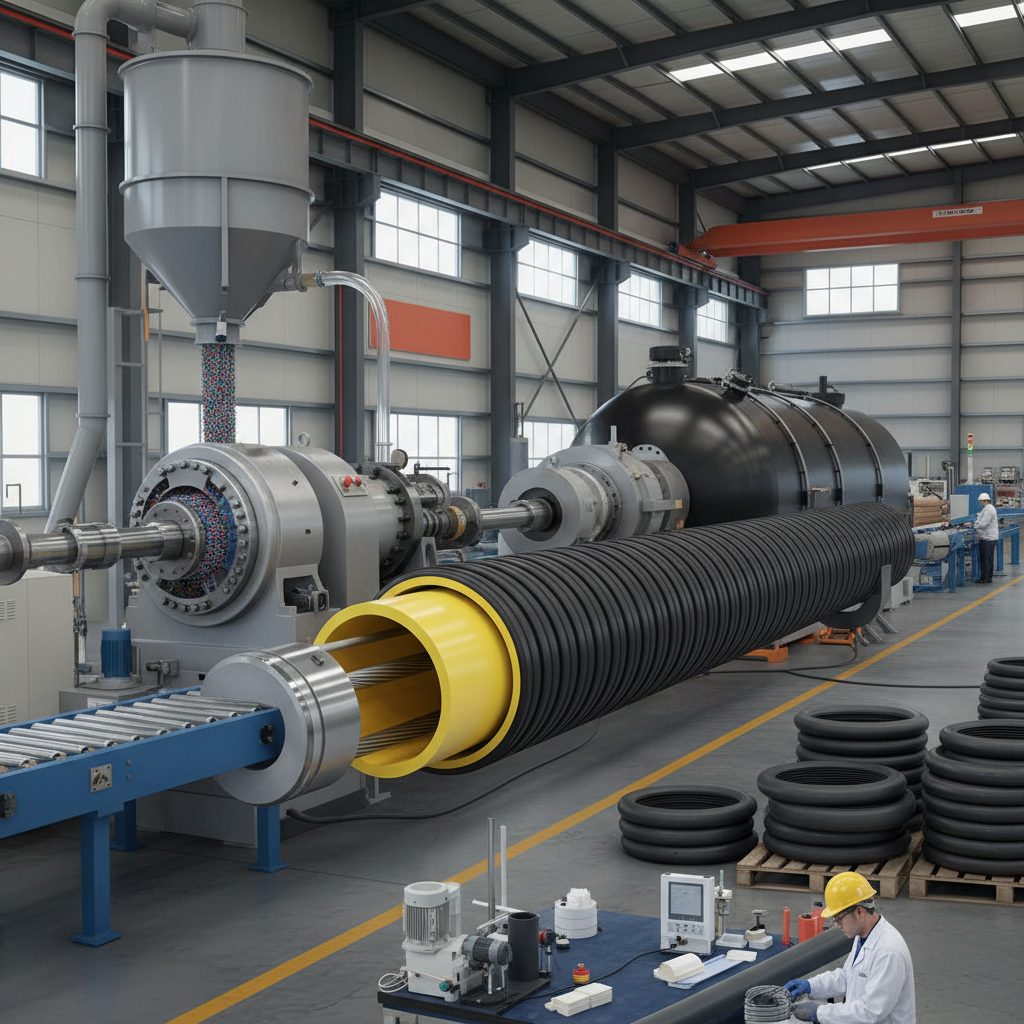
The reliability of pneumatic systems depends heavily on the structural integrity of the conduits used to transport compressed air. For procurement managers and plant engineers, sourcing from experienced air hose pipe manufacturers is no longer just about price, but about mitigating the risks of premature failure and unplanned downtime in critical production lines.
Operational failure in air hoses often stems from external abrasion, thermal degradation, or improper material selection for the specific environmental hazard. As industrial automation increases, the demand for hoses that can withstand repetitive flexion and harsh chemical exposure has pushed the industry toward more specialized rubber and thermoplastic compounds.
This analysis explores the technical selection criteria for pneumatic conduits, the impact of protective layering on service life, and how to evaluate the manufacturing capabilities of suppliers to ensure long-term operational stability.


Modern air hoses are engineered as multi-layered systems. The inner tube is designed for chemical compatibility and low permeability to prevent air loss, while the reinforcement layer—typically braided textile or steel wire—provides the necessary hoop strength to resist internal pressure.
The outer cover serves as the primary defense against environmental stressors. Depending on the application, this can range from synthetic rubber for oil resistance to PVC for lightweight flexibility, ensuring the conduit remains stable under varying thermal conditions.
Working pressure and burst pressure are the two most critical metrics. The safety factor, usually calculated as the ratio of burst pressure to working pressure, determines the hose's reliability under pressure spikes. Engineers must ensure that the chosen hose from air hose pipe manufacturers exceeds the system's maximum peak pressure by a safe margin.
Bending radius is another vital consideration. A hose with too rigid a structure may kink, restricting airflow and creating localized stress points that lead to fatigue failure. The balance between wall thickness (for pressure resistance) and flexibility (for installation) is a key technical trade-off.
Temperature range affects the material's elasticity. In cryogenic or high-heat environments, standard rubber may become brittle or overly soft, respectively. Verifying the thermoplastic or rubber grade against the operational temperature profile is essential to prevent catastrophic rupture.
In industrial environments, air hoses are frequently exposed to dragging, friction against concrete floors, and crushing by heavy machinery. This mechanical wear thins the outer cover, eventually exposing the reinforcement layer and leading to explosive failure.
This approach is particularly effective in mining and construction where replacing entire hose assemblies is costly. The guard wrap absorbs the impact and frictional energy, significantly reducing the frequency of hose replacement cycles.
The lifespan of a pneumatic hose is not linear but depends on the interaction between material grade and environmental protection. Hoses left unprotected in high-friction areas show a rapid decline in wall thickness.
By analyzing different protection levels, we can see a marked difference in durability. The following data represents a normalized engineering assessment of hose longevity based on protection levels.
In representative engineering scenarios, such as heavy-duty mining or automotive assembly, hoses are routed through tight channels and over sharp edges. In these environments, the synergy between the hose material and the fitting is critical to prevent leaks at the connection points, which are often the weakest links in the pneumatic chain.
Successful deployment requires a holistic view: matching the rubber air hose's chemical resistance to the facility's lubricants, while utilizing accessories like Spiral Guards to manage the physical wear associated with mobile machinery.
The industry has seen a shift toward hybrid materials. While traditional rubber offers superior flexibility and pressure handling, PU and PVC hoses provide better weight efficiency and cleanliness, making them ideal for food-grade or pharmaceutical environments.
However, rubber remains the gold standard for extreme pressure and high-flex applications. The development of specialized synthetic blends now allows manufacturers to create hoses that combine the oil resistance of Nitrile with the weatherability of EPDM.
Looking forward, the integration of smart sensors within the hose wall to monitor pressure drops or temperature anomalies is an emerging R&D direction, potentially transforming passive conduits into active diagnostic components.
When auditing potential air hose pipe manufacturers, procurement teams should look beyond the data sheet. The ability of a supplier to provide customized lengths, specialized fittings, and protective accessories like spiral wraps indicates a higher level of technical maturity.
A robust evaluation considers the manufacturer's quality control process, including pressure testing and batch consistency. Suppliers who prioritize a "reputation first" approach typically provide detailed inspection reports, reducing the risk of field failure.
The following matrix provides a framework for comparing different configuration profiles based on industrial requirements.
| Configuration Profile | Material Base | Durability Factor | Recommended Use Case |
|---|---|---|---|
| Basic Profile | Standard PVC | Low-Medium | Light workshop air tools |
| Standard Duty | Synthetic Rubber | Medium | General manufacturing lines |
| High-Duty Profile | Reinforced Rubber | High | Heavy machinery hydraulics |
| Precision Profile | Specialized PU | Medium-High | Automated robotic cells |
| Extreme Environment | Oil-Resistant Blend | Very High | Chemical processing plants |
| Industry Baseline | Braided PVC/Rubber | Medium | Agricultural irrigation |
The safety factor is the ratio between the burst pressure and the maximum working pressure. For standard industrial applications, a 3:1 or 4:1 ratio is common. For critical safety environments, engineers often specify a 5:1 ratio. You should always verify the burst pressure rating provided by air hose pipe manufacturers to ensure the hose can handle unexpected pressure surges without failing.
No, a spiral guard wrap is a mechanical protective layer, not a structural one. It protects against external abrasion and cutting but does not increase the internal pressure rating or chemical resistance of the hose. It is used as a supplement to an appropriately specified hose to extend its operational life in harsh physical environments.
Brittleness is typically caused by UV exposure (photo-oxidation) or ozone degradation, which breaks the polymer chains in the rubber or plastic. Exposure to extreme temperatures outside the material's rated range also accelerates this process. Selecting hoses with UV-stabilized covers or applying protective sleeves can mitigate these effects.
Visual indicators include "bubbling" of the outer cover, localized swelling, or visible fraying of the reinforcement braid. In professional settings, sonic leak detectors or soapy water tests are used. If the outer cover is breached and the inner reinforcement is visible, the hose should be replaced immediately regardless of whether it is currently leaking.
Polyurethane (PU) hoses are generally lighter, more flexible, and have better abrasion resistance than standard PVC, but they may be more susceptible to hydrolysis in very wet environments. Rubber hoses are superior for high-pressure applications, extreme temperature swings, and heavy industrial abuse, though they are heavier and less transparent.
Hoses should be stored in a cool, dry, and dark environment. Avoid stacking heavy items on top of hoses, as this can cause permanent deformation of the tube. Avoid exposure to direct sunlight and electrical motors (which produce ozone), as both accelerate the degradation of the rubber compounds.
The transition from simple conduits to engineered fluid transfer systems requires a detailed understanding of the interplay between material science and mechanical protection. By prioritizing the safety factor and implementing supplemental protections like spiral wraps, operators can drastically reduce the total cost of ownership for their pneumatic infrastructure.
Ultimately, the selection of air hose pipe manufacturers should be based on a combination of certified pressure ratings and the ability to provide comprehensive protection solutions. Investing in high-durability configurations today prevents the costly unplanned outages of tomorrow.